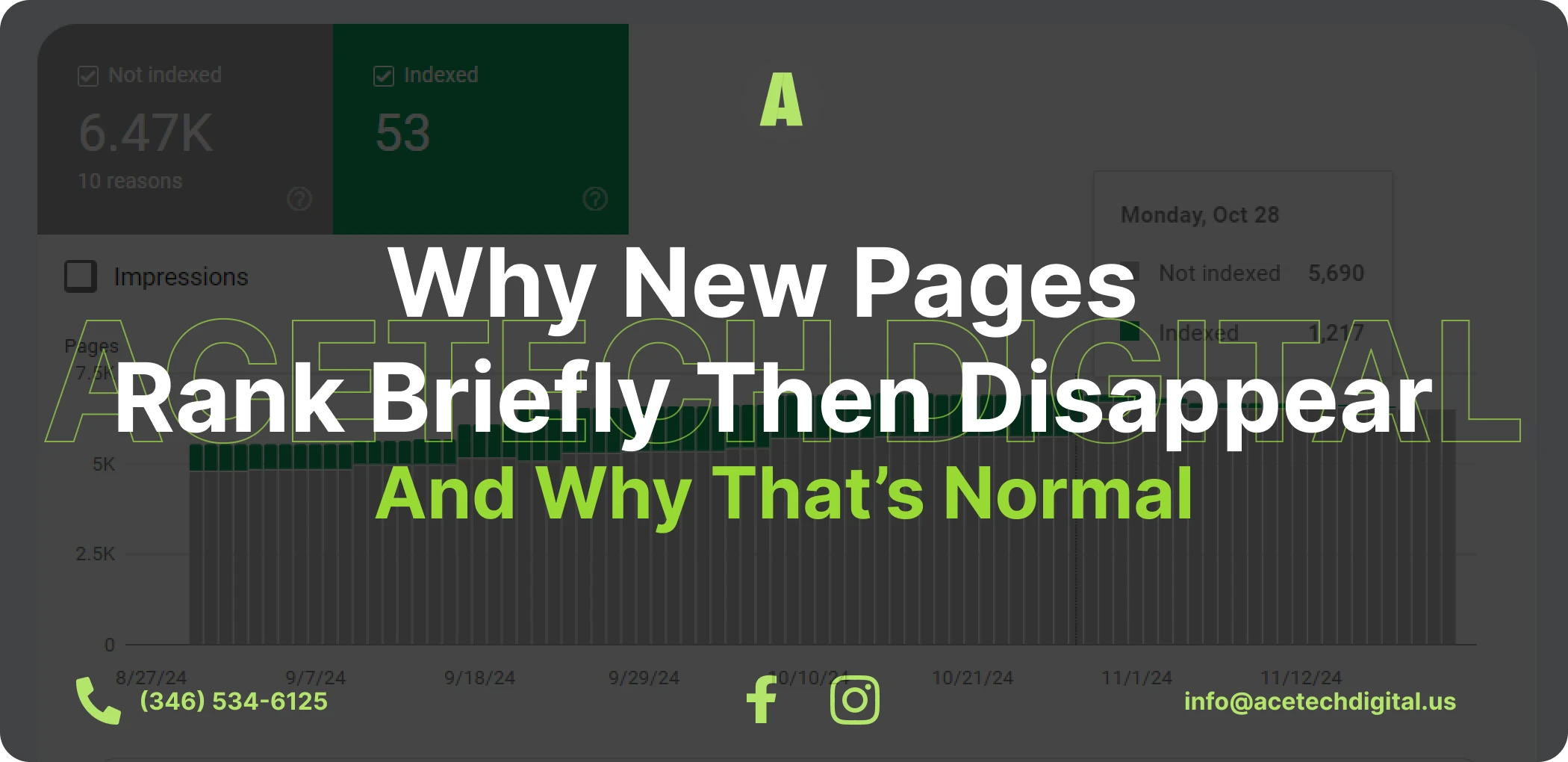
If you’ve been watching your rankings closely, you’ve probably seen this happen.
You publish a new page. It gets indexed quickly. Within days it starts showing impressions. Sometimes it even ranks on page one or two for a decent keyword.
Then a week later, it’s gone.
Impressions drop. Rankings vanish. You search manually and cannot find the page anywhere.
The first reaction is panic.
Something is wrong. Google penalized it. The page was too optimized. Maybe the content is bad. Maybe the site has an issue.
Most of the time, none of that is true.
What you are seeing is not a penalty. It is a test.
Google frequently gives new pages temporary visibility to understand how they behave in real search conditions. You can read more about how Google Search works and how crawling, indexing, and ranking decisions are made. This has been observed across thousands of websites. New URLs often receive early impressions before settling into a more stable position.
That early ranking is not a promise. It is an evaluation phase.
Google Tests Before It Decides
When a new page is discovered and indexed, Google has limited data about it. It understands the content and the structure, but it does not yet understand how users interact with it.
So it experiments.
It may show the page higher than expected for certain queries. It watches click behavior. It compares engagement signals. It evaluates whether the content appears unique compared to existing indexed pages.
If the page performs well and adds clear value, rankings can stabilize or grow.
If the page overlaps with other content or does not send strong quality signals, visibility often drops.
This is not a punishment. It is part of how search systems refine results.
Why This Feels Worse on Service Websites
Service-based sites experience this more intensely because many pages are structurally similar.
Location pages often follow the same template. Industry pages reuse similar service descriptions. Even blog posts can share overlapping themes.
When Google tests a new page in that environment, it is not only evaluating the page itself. It is also comparing it to your own existing content.
If Google sees redundancy or weak differentiation, it may decide the new page does not need long-term index priority.
That is when impressions spike briefly and then fall.
It looks dramatic in Search Console. In reality, it is Google adjusting confidence.
The Confidence Phase Most People Ignore
Ranking stability is about accumulated trust.
A brand new page has no history. No backlinks. No user data. No performance record.
Google assigns temporary exposure to collect signals. After that, it recalibrates. Google has publicly explained that multiple ranking systems evaluate content quality and relevance over time.
Research across large datasets has shown that many new pages experience ranking volatility in the first few weeks. This volatility decreases over time if the site consistently publishes useful, distinct content.
The key word there is consistently.
One isolated strong page is rarely enough to establish topical authority. Google looks at patterns across the entire site.
If multiple related pages reinforce each other, rankings stabilize faster. If pages feel isolated or repetitive, volatility lasts longer.
When Disappearing Is Actually a Good Sign
It might sound strange, but a brief ranking followed by a drop can mean the page is at least eligible.
Google indexed it. Google tested it. Google showed it.
That already tells you something important. The page is not blocked. It is not flagged. It is not filtered out completely.
It is simply being evaluated more strictly.
Pages that never rank at all are a different issue. Pages that rank briefly are participating in the system.
The goal is not to prevent volatility entirely. The goal is to shorten the volatility period and increase stability over time.
Why Internal Linking Matters Here
When a new page ranks briefly and then disappears, it often lacks support from the rest of the site.
Internal links act as signals of importance. They tell Google this page is part of a larger structure, not a random addition.
Linking new blog posts back to your core SEO services page helps reinforce commercial relevance. Linking between related blog posts builds topical consistency.
If you recently published articles about indexing issues or industry page performance, those are perfect supporting links. When content connects naturally, Google gains confidence in the topic cluster as a whole.
A page without internal context feels temporary. A page woven into the site architecture feels intentional.
Why Patience Is Part of the Process
It is tempting to edit a page immediately when rankings drop.
Changing headings. Rewriting sections. Adding keywords. Adjusting internal links repeatedly.
Constant revision can actually reset evaluation signals.
Google needs time to collect data. If the content changes drastically every few days, it becomes harder for the system to understand stable performance.
A more strategic approach is to publish, support the page internally, monitor impressions, and allow a few weeks for signals to accumulate before making structural changes.
Ranking drops in the first thirty to sixty days are common. What matters more is the long-term trend.
How to Reduce Volatility Moving Forward
You cannot eliminate ranking fluctuations, but you can reduce them.
First, avoid publishing pages that overlap heavily with existing content. Each new page should have a clear purpose.
Second, strengthen internal linking to your main SEO services page so Google understands the broader commercial context.
Third, continue publishing supporting informational content that builds topical depth. If you have already written about indexing behavior or why industry pages struggle without proof, link naturally to those posts when relevant. That cross-reference builds consistency.
Finally, focus on clarity. Pages that answer specific search intent tend to stabilize faster than pages trying to rank for broad, competitive phrases immediately.
Reframing the Drop
Instead of seeing a ranking drop as failure, see it as part of the filtering process.
Google is constantly refining results. Pages move up and down daily. What matters is whether the site shows steady improvement in overall impressions and indexed pages over months, not days.
Short-term ranking spikes are common. Long-term visibility is earned.
The sites that grow steadily are not the ones that panic after every fluctuation. They are the ones that build structure, proof, and consistency over time.
If your new page ranked briefly and then disappeared, it does not mean you are doing everything wrong.
It means Google is still deciding.
And that decision is influenced less by panic edits and more by overall site quality, internal structure, and accumulated trust.
Give the system something stable to evaluate, and over time, rankings tend to reflect that stability.