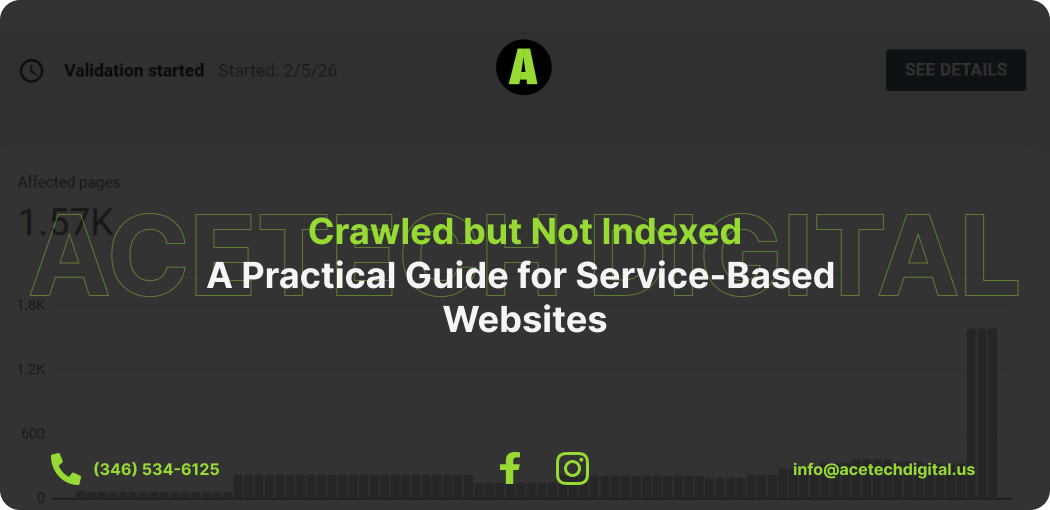
If you’ve ever opened Google Search Console, clicked on Pages, and seen a growing list under “Crawled – currently not indexed,” you know the feeling. It’s confusing, frustrating, and honestly a little scary the first time you see it.
Google found the page.
Google crawled the page.
But it decided not to show it in search.
For service-based websites, especially agencies and local businesses, this situation is far more common than most people realize. And despite what many assume, it’s rarely a penalty and almost never a sign that SEO is “dead” for the site.
In fact, this status is usually Google telling you something very specific. You just need to know how to listen.
What “crawled but not indexed” actually means
Let’s start with the basics, because misunderstanding this status leads to bad decisions.
When Google labels a page as crawled but not indexed, it means Googlebot successfully visited the page, processed the content, and then chose not to store it in the index at that time.
That choice is algorithmic.
There’s no warning email. There’s no manual action. And there’s no button you can press to “force” indexing long term.
Google indexes an estimated hundreds of billions of pages, but only a fraction of what it crawls makes it into active search results. According to Google itself, crawling does not guarantee indexing, and indexing does not guarantee rankings.
This is especially true for service websites that publish many pages targeting similar intent.
Why service-based websites see this issue more often
If you compare service websites to blogs or news sites, the difference becomes obvious.
A blog might publish 100 articles, each answering a completely different question. A service website, on the other hand, might publish 100 pages that all answer some variation of “Do you offer this service here?”
From a business perspective, that makes sense. From Google’s perspective, it creates overlap.
Google’s systems are designed to reduce redundancy. When multiple pages serve nearly the same purpose, Google will often pick a few and ignore the rest, even if all of them are technically fine.
This is why location pages, industry pages, and service variations are the most common URLs to fall into the “crawled but not indexed” bucket.
Crawled vs discovered vs indexed (in simple terms)
Understanding the difference here helps remove a lot of unnecessary stress.
When a page is discovered but not indexed, Google knows the URL exists but hasn’t visited it yet. This often happens on large sites where crawl budget is being stretched.
When a page is crawled but not indexed, Google has already seen the content and made a quality-based decision.
When a page is indexed, it passed Google’s internal filters and is eligible to appear in search.
That middle state is not an error state. It’s a filtering state.
The most common reasons this happens on service sites
There’s rarely a single cause. In most cases, several factors stack together.
One of the biggest reasons is content similarity. If you have dozens or hundreds of pages that follow the same structure, use the same headings, and differ only by a city or industry name, Google struggles to justify indexing all of them. Even if each page is “unique” by technical standards, they may not be unique enough by intent.
Another factor is authority vs scale. Many service sites are only a few years old but suddenly expose thousands of URLs. Google may crawl aggressively at first, index some pages, then pull back once it realizes the site hasn’t yet earned enough trust to support that level of scale. According to multiple large-scale SEO studies, newer domains tend to see indexing slowdowns once page count increases faster than backlink and brand growth.
Internal linking also plays a major role. Sites that place massive lists of location links in footers or sidebars unintentionally tell Google that every page is equally important. When everything looks important, nothing actually is.
Finally, many service-based websites lack informational depth. Studies consistently show that sites with a strong mix of informational and commercial content tend to earn links more naturally and index more consistently. When a site only publishes sales-driven pages, Google has less context to evaluate expertise.
Why pages sometimes rank briefly and then disappear
This is one of the most frustrating patterns.
A page gets indexed.
It starts showing impressions.
It might even rank for a short time.
Then it vanishes.
This behavior is usually the result of index testing.
Google often temporarily indexes pages to measure how they perform compared to similar results. It looks at engagement, relevance, and overall usefulness. If the page doesn’t outperform alternatives, Google may remove it from the index even if nothing is technically wrong.
This is why many service websites see impressions spike and then drop. Google isn’t punishing the site. It’s evaluating it.
What you should not do when you see this status
This is where many sites go off track.
Repeatedly submitting the same URLs through Search Console rarely helps. Google already knows the page exists.
Rewriting hundreds of pages without changing structure usually just creates new versions of the same problem.
Deleting large numbers of pages in a panic can remove internal signals that were still providing value.
And assuming you’ve been penalized often leads to aggressive fixes that cause real damage.
The key here is restraint and clarity.
A safer, more effective way to fix the problem
The goal is not to get every page indexed. The goal is to help Google clearly understand which pages deserve to be indexed.
Start by identifying your strongest pages. These are usually your main service pages, well-developed state or regional pages, and a limited number of city pages that actually represent meaningful demand. In many cases, fewer than 25 percent of a site’s URLs drive the majority of impressions.
Once those pages are identified, reduce noise. Pages that add little unique value don’t need to compete for crawl and index resources. Removing them from XML sitemaps or applying noindex temporarily helps Google refocus on your strongest content.
Internal linking should follow a clear hierarchy. Authority should flow from the homepage to services, from services to states, and from states to a small set of priority cities. City pages should link back up the structure, not laterally to hundreds of others.
This kind of structure makes indexing decisions much easier for Google.
Why informational content changes everything
This is the part many service websites underestimate.
Informational content is not just about traffic. It’s about context and credibility.
When you publish articles that explain real problems, share experience, and answer questions honestly, Google gains more confidence in your site as a whole. These pages often index quickly because they serve a clear purpose and don’t compete internally with dozens of similar URLs.
According to multiple industry studies, sites with strong informational content clusters tend to see higher indexation rates across commercial pages as well. Teaching builds trust, and trust improves indexing.
A service site that explains tends to be seen as more authoritative than one that only sells.
How long recovery usually takes
This part requires patience.
After structural changes are made, crawl behavior usually stabilizes within a few weeks. Index coverage reports move slowly, so it’s normal to see delayed updates. Impressions may fluctuate before leveling out.
In most cases, meaningful improvement happens within one to three months, depending on site size and how aggressive the cleanup is. That timeline is normal and healthy.
SEO rewards consistency, not urgency.
When it’s okay to let pages go
One of the hardest lessons in SEO is accepting that not every page needs to be indexed.
If a page doesn’t offer unique value, meaningful demand, or a clear role in your site’s structure, it’s okay if Google ignores it. Indexing everything is not a success metric.
Google prefers clarity over volume, especially for service-based websites.
Final thoughts
“Crawled but not indexed” is frustrating, but it’s rarely a sign of failure.
For service-based websites, it usually means the site expanded faster than Google could confidently evaluate. The fix isn’t forceful tactics or constant resubmission. The fix is focus. Fewer strong pages, clearer hierarchy, better internal linking, and real informational content create the conditions Google needs to index consistently.
Once Google understands what your site is truly about and which pages matter most, indexing becomes far more stable.
And stability is what leads to long-term growth.