If you’ve worked on SEO long enough, you’ve probably built industry pages that felt solid at the time. Clear service descriptions. Industry-specific wording. A clean URL. Everything “by the book.”
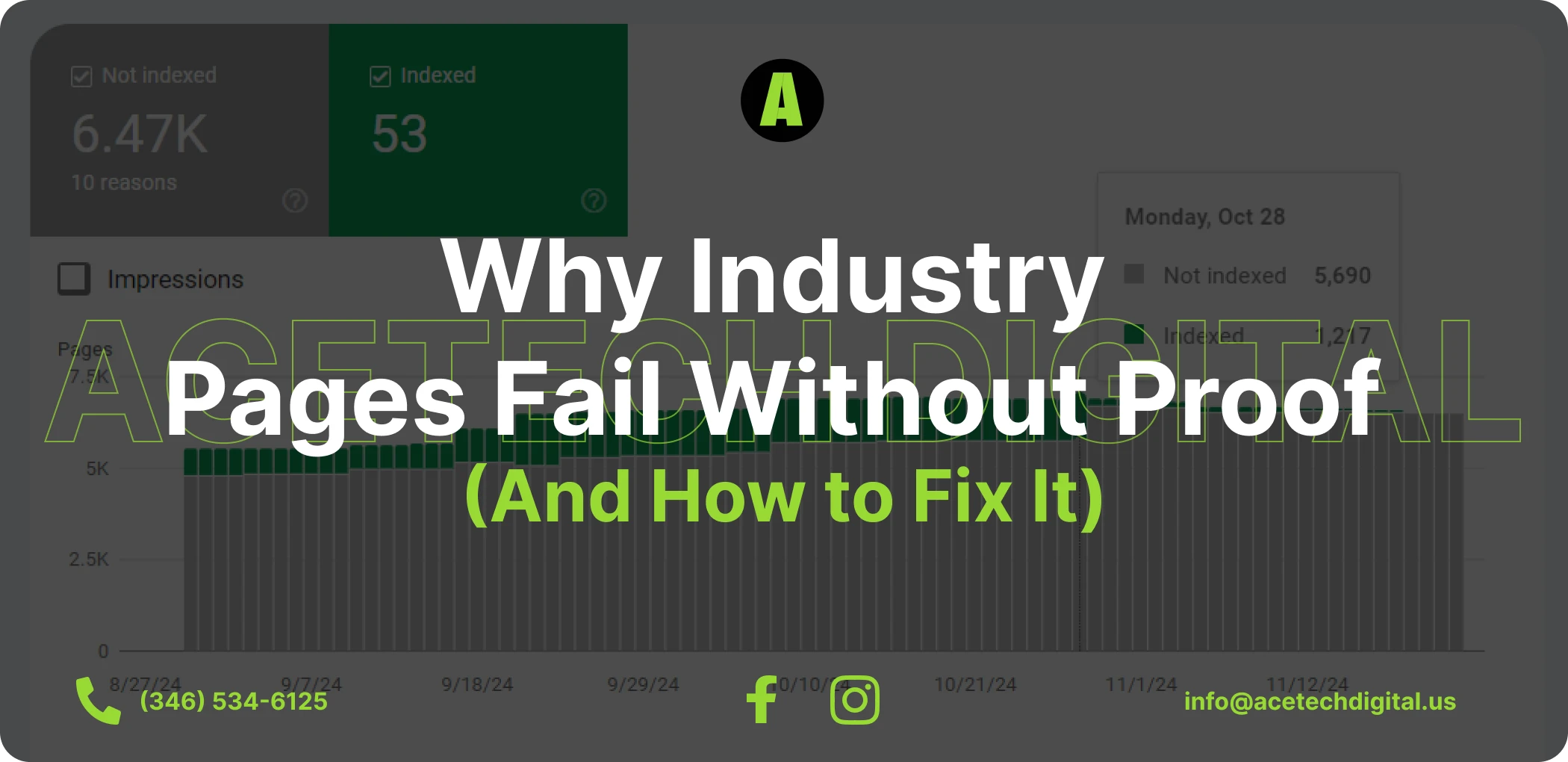
And yet, those pages either never index or they index briefly, show impressions, then quietly disappear.
That’s not a coincidence. And it’s not always a technical problem.
Most industry pages fail for one simple reason. They don’t prove anything.
From a business point of view, an industry page makes total sense. You want to show that you serve healthcare, construction, real estate, legal, ecommerce, or whatever niche you’re targeting. It enables stronger sales conversations, sharpens positioning, and aligns with how buyers think.
From Google’s point of view, logic isn’t enough.
Google doesn’t reward intent. It rewards evidence.
What Google Actually Sees When It Crawls Industry Pages
When Google crawls an industry page, it’s not asking, “Does this agency want to work with this industry?”
It’s asking something closer to, “Why should I believe this page deserves to exist?”
Most industry pages answer that question with claims instead of proof.
We work with healthcare businesses.
> We understand real estate marketing.
> We help contractors grow online.
Those statements aren’t wrong. They’re just unsupported.
From Google’s perspective, that creates a problem. If hundreds of agencies can publish nearly identical industry pages with slightly adjusted wording, then the page itself has very little standalone value.
This is one of the reasons industry pages often end up crawled but not indexed. Google understands what the page is about, but it doesn’t see a strong reason to store it in the index.
And when indexing pressure increases, which it has over the last few years, these are exactly the pages that get filtered out first.
Why Industry Pages Used to Work and Don’t Anymore
A few years ago, industry pages indexed more easily. Not because they were better, but because Google was more forgiving.
Back then, the index was less crowded. Service-based websites weren’t publishing thousands of near-duplicate pages. AI-generated content wasn’t flooding every niche.
Today, Google is much more selective.
According to multiple large-scale indexing studies, Google does not index a significant percentage of pages it crawls, especially pages that don’t add unique information. For service-based sites with templated or semi-templated content, that number can be shockingly high.
Industry pages fall right into that danger zone.
They often reuse the same structure, the same service descriptions, and the same benefits, just framed around a different vertical. To a human reader, that might feel acceptable. To Google, it looks like overlap.
The Real Issue Isn’t the Page. It’s the Lack of Signals Around It
This is the part most people miss.
An industry page doesn’t exist in isolation. Google evaluates it based on what surrounds it.
If your site has:
- No case studies
- No project examples
- No blog posts tied to real industry problems
- No client proof or experience signals
Then your industry page is standing alone, unsupported.
You’re essentially asking Google to trust a claim without showing any reason why that trust is deserved.
That’s why these pages often index briefly, get a few impressions, and then drop. Google tests them. It watches user behavior. It evaluates the broader site context. Then it decides the page doesn’t add enough value to keep.
Why “Well-Written” Isn’t Enough Anymore
This part can be frustrating, especially if you’ve spent time making the content sound good.
Clear writing helps users, but it doesn’t automatically help indexing.
Google doesn’t index pages because they’re polished. It indexes them because they contribute something that the index benefits from storing.
If your industry page says the same things your service page already says, just framed differently, Google sees redundancy.
From a business perspective, that feels normal. From Google’s perspective, it looks unnecessary.
That’s why linking industry pages directly to a core service page is important. It helps Google understand the relationship. But internal linking alone doesn’t solve the proof problem.
What “Proof” Actually Looks Like to Google
Proof doesn’t mean testimonials plastered everywhere or fake logos.
It means signals that show real-world experience.
Proof can look like:
- Case studies that mention specific industries
- Blog posts that solve real industry-specific problems
- Process explanations that reference actual client scenarios
- Examples of challenges you’ve handled in that niche
- Supporting content that only makes sense if you’ve done the work
Even one solid case study tied to an industry can do more for indexing than five generic industry pages.
Google doesn’t need perfection. It needs confirmation.
Why This Matters for Indexing, Not Just Rankings
A lot of people assume indexing is automatic and rankings are the hard part.
In reality, indexing has become the first filter.
If Google doesn’t trust the page enough to index it, rankings never even enter the conversation.
Industry pages without proof often fail at this first step. They’re not punished. They’re simply ignored.
And ignored pages don’t show up in Search Console as errors. They show up as crawled but not indexed, or discovered but not indexed. Quiet. Neutral. Easy to overlook.
How to Fix Industry Pages Without Putting Your Site at Risk
The fix isn’t deleting everything or starting over.
It’s about changing the role industry pages play on your site.
Instead of treating them as standalone landing pages meant to rank on their own, treat them as context pages. Their job is to connect.
Each industry page should clearly point to:
- Your main service offering
- Any relevant supporting content
- Real examples, even if limited
Internally link each industry page to your top industry page so Google sees a hierarchy, not a collection of isolated URLs.
Link them to your core service page so Google understands they’re supportive, not competing.
And most importantly, start building content that proves experience over time.
Why This Sets Up Future Case Studies Perfectly
Here’s the long-term advantage most teams miss.
Once you publish case studies, industry pages suddenly gain weight.
That’s when they start making sense to Google.
An industry page that links to a real case study becomes a navigation point, not just a claim page. It helps Google understand your site structure and your expertise.
Even if you don’t have case studies today, building industry pages with that future in mind prevents rework later.
You’re not fixing a problem temporarily. You’re building a foundation Google can grow into.
What to Expect After You Fix This
Don’t expect instant rankings.
What you should expect instead is stabilization.
Pages that were deindexed may start staying indexed longer. Impressions may grow slowly instead of spiking and crashing. Crawl behavior becomes more consistent.
That’s how trust rebuilds.
Google rarely flips a switch. It watches patterns over time.
When industry pages are supported by proof, structure, and internal links, they stop looking like filler. They start looking intentional.
And intentional pages tend to survive.
If you want to understand this process more clearly, Google also explains how crawling and indexing actually work and what influences those decisions.